Just as drones have overtaken traditional infantry, armour and artillery weapons in land war, podcasts are transforming the warfighting weapons on the media battlefield.
This is the first history of war and peace podcasting and of the big-click, fat-money, heavy-weapon podcast names.
Just in time, too, because the evidence uncovered in this book reveals that the podcasters have already hit their peak in viewers and influence. Audience fatigue is setting in; clickbait exaggeration, sensationalism, and fakery are replacing investigative journalism.
Attracted to the podcasters as the newest and most influential of the mass media, the info-warfighting agencies of the US, UK, Russia, China, and Iran are making the podcast impresarios and their guests an offer they find it difficult to resist. Money for propaganda – this is the iron law of media in wartime. The first casualty is investigative journalism, reporting the truth.
There is a second iron law – it’s the old imperial idea of diverting dissent and pulling in crowds with bread and circuses. Blood, too.
Case studies of the war and peace podcasts most popular with audiences in the English-language world reveal why they are failing to stimulate anti-war movements and political parties opposed to the Trump empire’s wars. These podcasters have turned into carneys outside the circus tent – pitching snake-oil cures, advertising exorbitantly priced products to keep as a memento of a night’s entertainment, then replace when the next circus rolls into town
This isn’t journalism, it isn’t politics; it isn’t even armchair warfighting. It’s action gaming — the intellectual equivalent of custom robos which blast away at each other until the commander’s robo has won all the hit points and destroyed the rivals.
Russian robos and Iranian robos versus American, Ukrainian, German, British, and Israeli robos.
This game is fun to play for a short while, but it’s factless, feckless too, because the winner is always the commander’s robos, otherwise the game wouldn’t be worth playing. For gamers, there’s no fun in losing.
This is why in podcasts like Judging Freedom, The Duran, or Greater Eurasia Podcast, the commander’s Russian and Iranian robos are always within days, weeks or months of winning their wars — and always certain to win. The robos with recognisable podcast names are always winning their games, always wrong on the battlefield: if they weren’t robos, this would be a disqualification from the game.
Here is the truth the media manipulators don’t want you to know, and the financial report of the fortunes they are earning in secret for manufacturing false consciousness for their state paymasters, and for deceiving you.
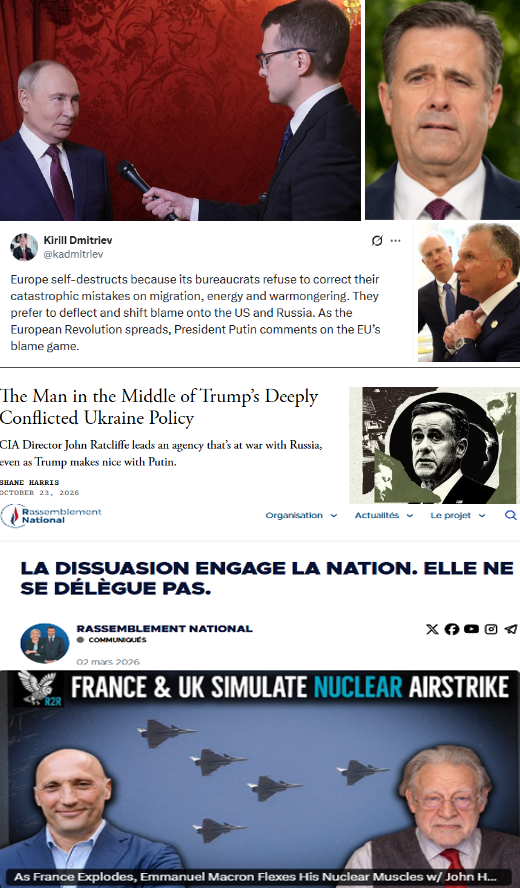
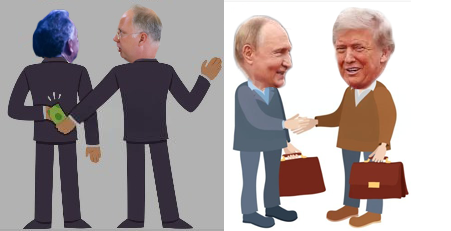
In Moscow last week (October 22), President Vladimir Putin (lead image, top left) told a reporter that he thinks the people of Europe can stop the war against Russia, and President Donald Trump too.
“It has become obvious to everyone,” Putin said, “that it is impossible to defeat Russia on the battlefield, and it is unrealistic to inflict a strategic defeat on it. And I think that those people who have always sought to strategically weaken Russia — and, unfortunately, such people still exist today — are aware of the realities of modern life and understand that it is better to live in peace with Russia. This aligns with the interests of their peoples.Because, if you look at the political processes taking place in Europe, it becomes obvious that the peoples of Europe do not want to go to war with Russia.”
At the same time CIA Director John Ratcliffe (top right) arranged for spokesmen to tell The Atlantic, not only that he, the Agency, and the Trump Administration think it is realistic to inflict a strategic defeat on Russia, but also that “the CIA’s operations are now much more aggressive than they were during the Biden administration.”
Putin concluded his remarks with the reporter by linking current negotiations on the Ukraine war with the broader strategy of security for Russia in Europe. “The representative of the US administration [Steven Witkoff] pointed out that if we are to discuss some future security arrangement for both Ukraine and Russia, then of course we will need to talk about the broader European security architecture. And I agree with this too.”
Amplifying on Putin’s remarks, Kirill Dmitriev (second row, right), the Kremlin negotiator with Witkoff, tweeted his confidence that a revolution for peace is just around the corner, if only the Europeans opposed to Trump and to Putin would mend their ways. “Europe self-destructs,” Dmitriev announced on October 25, “because its bureaucrats refuse to correct their catastrophic mistakes on migration, energy and warmongering. They prefer to deflect and shift blame onto the US and Russia. As the European Revolution spreads, President Putin comments on the EU’s blame game.”
The destruction of the Libyan people has been attempted three times in the past century – the first by the Italians between 1911 and 1939; the second by the Germans between 1939 and 1943; and the third by the Americans, British and French from 2011 until now.
Three times the outcome has been genocidal. In the Middle East, only Palestine, Iraq and Iran have suffered as much, for as long, and still today from the same sources.
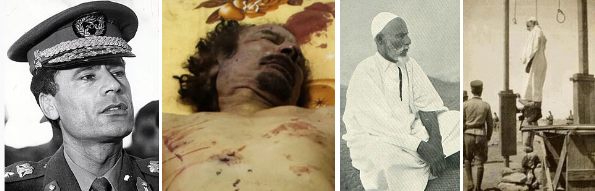
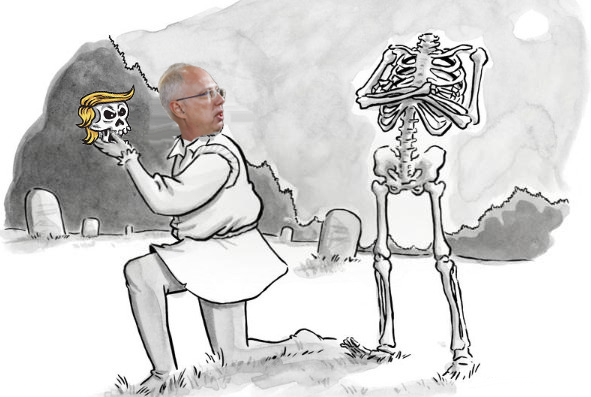
Three US presidents, Jimmy Carter, Ronald Reagan, and Barack Obama, have personally plotted the overthrow and assassination of Muammar Qaddafi (lead images, left) , just as Benito Mussolini had Omar el-Mukhtar (right). Qaddafi was executed on October 20, 2011; al-Mukhtar on September 16, 1931.
Obama’s Secretary of State Hillary Clinton said: “We came, we saw, he died.” Al-Mukhtar said: “We do not surrender. We win or die. This is not the end. You, the next generation, and the generations after you have to fight. My life will be longer than that of my hangman.”
At the start of the Jamarl Thomas Morning Show, on the fifteenth anniversary of Qaddafi’s death, we remember the genocidal purposes of the Americans and Europeans in Libya, and its consequences for the Middle East, Europe, and the US. There wasn’t time or opportunity to discuss the betrayal of Libya by ex-President Dmitry Medvedev, nor the subsequent policies of President Vladimir Putin – secret military operations, secret arms dealing, secret collaboration with the Turks, and secret refusal to support the Qaddafi family through Aisha Qaddafi and Saif Qaddafi. Saif was murdered on February 3 of this year.
Instead, we focus on the meaning of Putin’s meeting with White House negotiator Steven Witkoff, and the credibility for Iranian officials in Teheran of this remark of Putin’s to Witkoff; “Russia has a special, trusted relationship with Iran, our partners in Iran and our friends, because this relationship has developed for decades. If we can do anything for settling this crisis, we will be glad to help.”
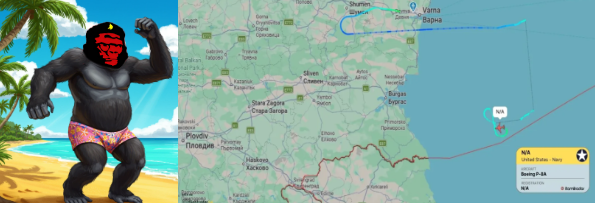
This week the US Navy sent one of its maritime surveillance aircraft, the Boeing P-8A Poseidon, on a special mission off the coast of Bulgaria in the Black Sea.
According to the Itamilradar.com website (lead image, Itamilradar map) which monitors NATO air and naval operations in the region, “the flight track shows the aircraft operating over the western Black Sea, east of Varna, before making several turns over the maritime area. According to the available tracking data, portions of the mission were flown below 9,000 feet, a profile consistent with maritime surveillance.”
“This is an important distinction. While the P-8A Poseidon can perform intelligence, surveillance and reconnaissance missions, it is also specifically designed for maritime patrol, anti-submarine warfare and the detection and tracking of surface vessels. Its flight profile alone cannot establish the exact mission, but the prolonged activity at relatively low altitude supports the assessment that maritime patrol was a significant part of today’s sortie. The deployment comes against a particularly tense backdrop. In early October, two merchant ships were attacked by aerial and maritime drones inside Bulgaria’s exclusive economic zone, with one vessel sinking. Further attacks were reported off Bulgaria and Romania in the following days, including incidents involving ships in Romanian territorial waters. These incidents have raised concerns about the vulnerability of commercial shipping along NATO’s southeastern flank. Although an exclusive economic zone is not equivalent to territorial waters, attacks there can still threaten vital maritime routes and create significant security challenges for coastal states.”
“A P-8A operating in this environment can help build a clearer picture of maritime activity by combining radar surveillance, electro-optical sensors and other mission systems. Depending on the tasking, it can contribute to identifying vessels, monitoring suspicious movements and supporting a broader maritime situational awareness picture.”
“Suspicious movement” – to the NATO allies, including Bulgaria which joined the alliance in March of 2004, that means Russian civil cargo and military movements in the Black Sea.
According to the Italians, the Poseidon flight is news-breaking. “It had been several months since we last tracked a US Navy P-8A conducting a mission over the Black Sea, making today’s activity noteworthy independently of the current security situation.”
The NATO reason for it is twofold: on the one hand, the allies are trying to break the Russian blockade of military supplies moving inward to the Ukrainian coast, and of Ukrainian wheat and other grains moving outward. On the other hand, Turkey is trying to preserve its Russian gas, oil, coal and steel supplies from attacks by NATO-guided, Ukrainian-operated air and sea drones, and assert its 90-year Montreux Convention role as the guardian of the Black Sea through the Bosporus and Dardanelles straits. The Turks are worried that the spillover of NATO’s war with Russia may strike at these straits as the US wars against Iran and Ansar Allah are striking at the Hormuz Strait and the Bab el Mandeb.
In this morning’s new Gorilla Radio podcast with Chris Cook, we discuss what the US, Turkey, Bulgaria and the others in the war against Russia aim to achieve in their Black Sea operations at the moment. Click to listen, starting at Minute 30: https://gradio.substack.com/p/gorilla-radio-with-chris-cook-debbie
For background on the new Bulgarian chapter of the Black Sea game, read this.
This week too, the Kremlin-sponsored Vzglyad security analysis publication reported in unusual detail on Turkey’s attempt at a protected shipping-lane arrangement for Ukrainian and Russian cargo movements. This new report, translated into English verbatim, explains why, for the time being, Russia refuses to accept this Black Sea plan.
“Never in our history have Iran and Russia worked as closely as now”, Foreign Minister Abbas Araghchi said on meeting Foreign Minister Sergei Lavrov on Tuesday (October 20).
This was not a diplomatic nicety, nor is it an academic exaggeration. The history of distrust and warfighting between their two states is more than two hundred years long. It was vivid on the Iranian side when they resisted General Alexei Yermolov in the Caucasus wars of 1805-1813 and on the Russian side, the revenge killing of Alexander Griboyedov, dragged out of the Russian embassy in Teheran and murdered on January 30, 1829.
For knives in the back, steel ones and figurative ones, Araghchi remembers Joseph Stalin’s scheming in the 1940s for an Azeri secession and with Prime Minister Qavam al-Saltaneh for a coup against the Shah. Lavrov remembers Araghchi’s predecessor, Mohammed Javad Zarif, as a backstabber and liar in 2021.
Mohsen Rezaei, head of the Supreme National Security Council, whom Lavrov also met in Teheran on Tuesday, remembers with the Islamic Revolutionary Guard Corps (IRGC) he once commanded, the record of President Vladimir Putin’s collaboration with Israel in their operations in Syria – against IRGC forces and commanders, and against the Bashar al-Assad presidency.
In the official Russian communiqué, and then more explicitly in the press conference, Lavrov emphasized “strengthening the comprehensive strategic partnership in the light of the agreements reached following the meetings of the Presidents of Russia and Iran in Bishkek (Kyrgyzstan) on 1 September and Avaz (Turkmenistan) on 8 October.” “Russian-Iranian cooperation is developing dynamically, contrary to known circumstances. We have a solid foundation for further forward-looking progress. This is the renewed basic interstate treaty that came into force on October 2, 2025, which for the first time recorded our relations at the level of a comprehensive strategic partnership. Russia proves its commitment to this fundamental document.”
Lavrov means that the requirements for Russian collaboration in military and intelligence-sharing with Iran of the strategic partnership pact of January 2025 are being met now, and will continue to be honoured by the Kremlin despite the “known circumstances” – that’s the euphemism for US warnings and threats, including Secretary of State Marco Rubio’s summons to Lavrov of July 13, 2026.
Lavrov was defending Putin against his Iranian doubters and attacking the Americans. He was replying to President Donald Trump’s claims, tweeted on October 18 and repeated the next day, October 19. “Russia is doing very little, if anything, to help the Islamic Republic of Iran, compared to what they could be doing, and I want to keep it that way”, Trump had written. Putin, he told reporters, “[is] laying off Iran, that’s nice because we’re hitting Iran very hard, as you know, and economically as well as militarily. And Russia has done nothing there that we can see, and I think that’s a very positive. And of course, we’re negotiating with him on Ukraine. So, I’m not looking to break up negotiations right in the middle… I’m in the midst of negotiating a deal. When you’re negotiating a deal, you don’t do that to the people you’re negotiating with. And the deals — the Ukraine deal. Also, I’m negotiating with them [Putin] on Iran because they’ve been very well-behaved on Iran.”
“Russia could have done a lot more? That’s right, Russia could have done a lot more to help. If you put it bluntly, Russia could have done a lot more to help Iran. Russia has done very little for Iran.”
Trump had been briefed to contradict Rubio’s warning to Lavrov, and to play up Iranian suspicion of Putin’s readiness to betray the 2025 strategic partnership treaty in exchange for Trump’s concessions on Ukraine war terms.
Lavrov asked Araghchi and Rezaei to believe Russia’s “commitment to this fundamental document”, and to set aside Putin’s record. Araghchi’s reply of “never in our history” was a vote of confidence. One vote.
Lavrov went further: “Despite the difficult situation mentioned, Russia does not intend to abandon the implementation of agreements with Iran in the economic and investment spheres. Our specialists are gradually returning to the Bushehr nuclear power plant. We have great prospects in the field of hydrocarbon production and transportation. The Russian contractor continues engineering research on the route of the future railway Resht-Astara and will begin construction as soon as the Iranian side completes the registration of the necessary documents…
We believe that it is important to return to the pre-crisis situation in the Persian Gulf and the Strait of Hormuz, including the restoration of freedom of navigation and guarantees of non-repetition of aggression. We appreciate the efforts of international mediators who are trying to facilitate the achievement of such a reliable agreement. It is important to resume dialogue on the situation in and around Yemen. It is optimal to return to the road map, which was developed in Saudi Arabia in 2023 and was acceptable to both the internationally recognized authorities in Aden and the Ansar Allah movement.”
Lavrov’s reference to the Russian return to Bushehr was an attempt at undoing the damage Putin had done when he revealed he had reached an agreement with Israeli Prime Minister Benjamin Netanyahu that neither he nor the Americans would strike at the Bushehr reactor during the June 2025 war against Iran. Read what Putin said on June 19, 2025. And for analysis of that episode, click here.
Those remarks of Putin’s on June 19, 2025, created a unique problem which Lavrov cannot easily resolve.
Asked by Karim Talbi of Agence France Presse, “if tomorrow Israel – with or without US assistance – were to assassinate Khamenei, what would be your reaction, Russia’s response, and your immediate actions?” Putin had replied: “I do not wish to even discuss such a possibility. Karim Talbi: But they are openly discussing it – Mr Trump, Mr Netanyahu. Vladimir Putin: I am aware of these statements. But I do not wish to even discuss this.” Why was Putin refusing to condemn the threats of assassination – Iranian officials asked at the time.
When Khamenei and then Ali Larijani, head of the Supreme National Security Council, were assassinated by Israeli and American operations in February and March 2026, why did Putin respond with evasions and euphemisms?
The previous June, the French reporter had pressed Putin to answer a second question: “Given the current escalation [June 2025], are you prepared to supply Iran with new types of weapons to enable its defence against Israeli strikes?”
Putin answered: “You know, we once proposed to our Iranian partners cooperation in air defence systems. At the time, our partners showed limited interest, and the matter concluded there.
Regarding the Strategic Partnership Treaty you mentioned, it contains no clauses pertaining to defence cooperation. That is the second point.”
Putin’s second point was false, Iranian officials knew at once. Articles 4 and 5 of the treaty expressly require “exchange of information” and “cooperation” between the “intelligence and security agencies”, including “cooper[ation] within the framework of separate agreements.” The defence cooperation spelled out in Article 5 is detailed and comprehensive, and includes “countering common military and security threats of a bilateral and regional nature.”
Was Putin lying clumsily about these provisions of the pact? Or was he making a specious distinction between the pact and the “separate agreements” which the treaty delegated to a secret “Working Group on Military Cooperation”? In private, Iranian officials believe both.
Article 3(3) of the strategic partnership treaty also provides that “in the event that either Contracting Party is subject to aggression, the other Contracting Party shall not provide any military or other assistance to the aggressor which would contribute to the continued aggression, and shall help to ensure that the differences that have arisen are settled on the basis of the United Nations Charter and other applicable rules of international law.”
Iranian officials have pressed Lavrov to say if Putin will allow fresh Russian weapons transfers to Saudi Arabia and the UAE during the present war; and whether the treaty commitment to Iran requires Russia to block the proposed Turkish transfer of S-400 missile batteries to Saudi Arabia, if the latter requests the transfer under the terms of the Mecca pact with Turkey.
There has been no clear answer from Putin. On Tuesday, asked for Russia’s interpretation of the Mecca pact, Lavrov implied that he believes it should not be directed against Iran: “As for the Pact of Mecca, this is another configuration – Pakistan, Turkey and the Kingdom of Saudi Arabia. We welcomed the announcement of the formation of such a structure. We believe that the goals of this association are to achieve stability, promote peace and cooperation. We know that some other states of the region, including Arab countries, are showing interest in joining the work of this ‘troika’. If, at some stage, the leadership of the Islamic Republic of Iran has decided that contacts with this structure can contribute to the advancement of the world and free development, we will respect this choice of our friends.”
The Iranian interpretation is that this is waffling by Lavrov because he lacks the power to commit Putin, and because he does not know what Putin will decide.
Following his meeting with Lavrov, President Masoud Pezeshkian published a cautious endorsement of Lavrov’s promise. “Emphasis. The necessity to accelerate the implementation of Tehran-Moscow agreements and understandings — Strengthening bilateral cooperation — The necessity to move beyond unilateral approaches.” Pezeshkian was saying through Lavrov to Putin to stick to the agreement he has signed, and to avoid separate deals that undermine the pact with “unilateral approaches”: that’s Persian for telephone calls with Netanyahu and Trump.
About his meeting with Lavrov, Supreme National Security Council Secretary Rezaei has kept silent.
For the time being, the Iranians have been less convinced than Araghchi has tweeted that Trump is not telling the truth when he claimed Putin is “very well-behaved on Iran.”
In the new podcast with Nima Alkhorshid, we focus on the Russian moves towards the Iran war; the Ukraine war negotiations with Trump and the Europeans; and in the last minutes of the discussion, the anti-Muslim and white racist appeals which the Kremlin representative Kirill Dmitirev is making on the events in France and Spain. The podcast went to air on Tuesday afternoon, Moscow time. Click.
by Editor - Tuesday, October 20th, 2026 No Comments »
This is the story of how recent calculations by President Donald Trump, Vladimir Zelensky, and President Vladimir Putin have come up short more quickly than they were expecting.
It’s a short story — Trump’s is the shortest of the three.
Trump and Zelensky have believed that the war which they, their allies, their media, and their voters – their predecessors too, going back a hundred years – have been waging against Russia was succeeding slowly, at a price they could afford to pay over time, but Putin could not. In time, they calculated, their war would break Putin in the Kremlin and push Russia into a chaos from which they would profit at the Russians’ expense.
It’s the strategy of overthrow from within, driven by pressure from without, which succeeded in just five years with Mikhail Gorbachev, and then in ten years with Boris Yeltsin. It’s also the same Anglo-American and German strategy which failed the first time with Vladimir Lenin, and failed the second time with Joseph Stalin.
On the evidence of the most recent Russian public opinion polling – measured by the Levada Centre of Moscow one week after Russian voters had gone to the national parliamentary election – this calculation isn’t entirely mistaken. “In September… the level of support for the actions of the Russian military remains high; seven out of ten respondents support the actions of the Russian military in Ukraine. At the same time, two-thirds of respondents are in favour of the transition to peace negotiations; only one-quarter for the continuation of hostilities. Most of the respondents would support Vladimir Putin’s decision if he decided ‘right now this week’ to end the military conflict with Ukraine. However, if the end of the conflict would require the return of the annexed territories, only one-third of the respondents would support such a decision.”
When the Levada pollsters divided their voter sample into those who would support Putin ending the war unconditionally — accepting a ceasefire in place and returning the annexed territories — and those who baulked at these conditions and opposed such a settlement, the result was a split between men and women, the higher and lesser educated, the big-city and provincial residents, and those who depend on the alternative media for their news instead of the mainstream media.
It is clear that the allied and Ukrainian targeting of the drone and missile attacks in the Russian hinterland has aimed at those young, urban, middle-class Russians already least supportive of continuing the war. This has been a political gaming strategy which Trump and his officials have shared with NATO and with the Kiev regime.
“Mr. Zelensky has to do one thing,” Trump tried explaining this strategy at an Irish golf course on September 13. “He has to stop knocking out diesel fuel in Russia. Let him go after targets, but not diesel fuel ’cause he’s causing a shortage of diesel fuel. This isn’t done by the Middle East, this is done by what’s happening with Russia and Ukraine. So, uh, we spoke to Mr. Zelensky about it. There are plenty of other targets. Don’t hit diesel fuel because that’s hurting, that’s hurting the world. We don’t want him to hit diesel fuel. He has to stop knocking out diesel fuel in Russia. Let him go after targets but not diesel fuel, because he’s causing a shortage of diesel fuel.”
Trump’s calculation was that he could appeal in this fashion to US voters to neutralize the blame they were putting on him for fuel price inflation, and thereby to reverse the decline in Republican Party votes ahead of the November 3 Congressional election. He was asking Zelensky to help; he was calling him mister.
This invited Putin’s calculation that he could drive a wedge between the two of them by offering Trump the diesel he wanted to turn into votes. In the five weeks since September 13, this is how the cards were played. Except that the diesel traders and US voters have not been persuaded: the New York Harbor marker price for diesel price went down from its mid-September peak; rose again; fell again; and is now higher than it was in response to Putin’s offer to start shipping Russian diesel in exchange for Trump suspending sanctions on the shipments and the tanker trade.
Not a drop of the Russian diesel has landed at a US port. Zelensky has continued to strike refineries and terminals in Rostov, Ryazan, and St Petersburg as his targets. Trump has dropped the mister.
“Zelensky,” he tweeted on October 18, “is using Diesel Refineries in Russia as a target, knowing that these attacks are seriously hurting the world diesel markets, including those in the United States. Farmers, ranchers, and businesses of all kinds are suffering greatly from this, but Russia is, nevertheless, sending, at a low price, millions of barrels of diesel to the World. Zelensky doesn’t care, and frankly, with all of the money that Europe is famously giving him, and that Crooked Joe Biden gave him in the past, he doesn’t want to end this war, and probably never did. He could have made a better deal two years ago than he can now. His country is in shambles, a large portion of his land is lost, his oceans and seas are gone, and his male population is low, wounded, and/or dead.”
Putin’s calculation is that with Trump he can achieve an end to the war on the Ukrainian battlefield for the time being; gain the time the General Staff is requesting to prepare for the wars the US alliance is directing on other fronts; to deliver terms which Russian voters will accept; and secure a stable succession for himself and the oligarchs on whom Putin has depended from the very beginning. Trump’s corruption was his opportunity, and he calculated there isn’t much time left to play it.
“In this situation, bribing Trump is the only card Putin has,” says a Moscow source in a position to know, “— and at the moment you can see for yourself, it is producing results.”
“There is no diesel deal with Trump worth anything. That is not the point. This non-deal is not the point at all. It is all about making Trump perform in a manner that can bring some benefit in money and some benefit in discord in NATO to the Russian side. That’s all it is, and it is working. There is no question bribes have already been paid. Whether for Trump family weddings, gifts, crypto business – you name it, it’s been paid. The Russian oligarchs and the Kremlin gladly play these games to free up their own money and take some advantage in the battlefield.”
“Trump will not hand the war and terms to the Russians but his actions will help. You can see the Europeans are coming around to the position that they cannot give any more money and they can’t act alone without the US. So the statements from Trump help in dissuading the weaker Europeans, and add to the pressure on the stronger ones. All this is helping. A corrupt Trump helps the Russians.”
“In this situation, continuing to dangle bribes and bribing his children, achieves the purpose.”
“The question for us is how much compromise Putin will make; I believe he will make a few, knowing fully well that the active phase of war does not give all the gains that were hoped for; and that passive long-term war with Europe needs preparation and freeing up the economy from sanctions. Plus, he is now admitting publicly that he did not foresee the attacks on data centres; refineries; and other civilian objects. This means there was nothing like the tacit understanding which Putin believed there was – just his expectation that the Americans, Brits, Germans and French wouldn’t go so far, would be deterred by the threats he and [Foreign Minister Sergei] Lavrov have been making. His expectations for Trump and the Americans have come out obviously wrong. After letting the Libyans, Syrians, Iranians, Cubans, Venezuelans down, Putin is sticking to expectations his enemies believe have proved wrong. That’s why they continue to be confident that if they keep up the war pressure for two more years, they will succeed against Putin as they had against Gorbachev and Yeltsin. They are confident Putin has no Stalin cards to play.”
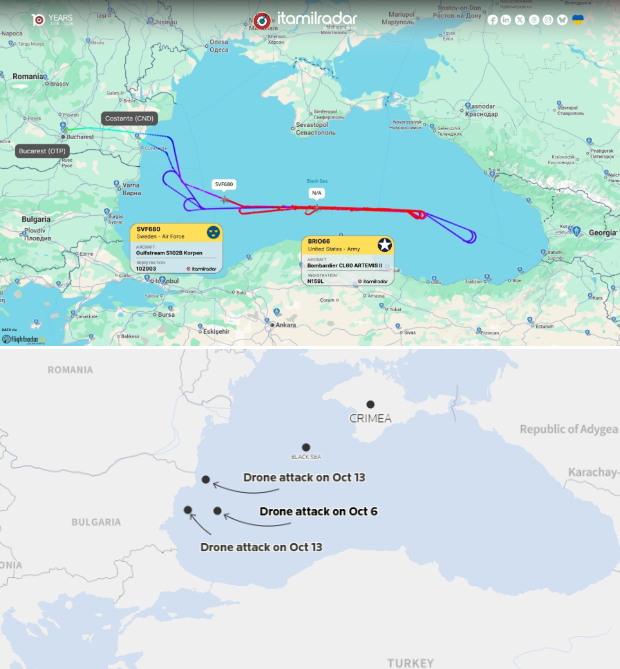
For three consecutive days last week, October 5-7, specially equipped intelligence-gathering aircraft of the Swedish Air Force and the US Army flew multiple missions over the southern area of the Black Sea, taking off from bases in Bucharest and Constanta, Romania, and concentrating on the Bulgarian coastline and territorial waters to the east; the northern Turkish coast; and Georgia (lead image, top map).
The Italian military monitoring site, Itamilradar.com, reported the flights as a big change in NATO operations in the region.
“What makes today’s activity particularly interesting is not the individual missions, but their overlap. The two aircraft are operating simultaneously over the same strategic area while approaching the mission from different basing arrangements and with different sensor configurations. This creates a more layered intelligence picture: the Korpen [Swedish Air Force] can contribute its specialized SIGINT collection, while ARTEMIS II [US Army] provides another US-operated source of electronic and communications intelligence. The combination is therefore more significant than simply counting two reconnaissance aircraft in the same area. The pattern also underlines the importance of Romania as an ISR [Intelligence, Surveillance, Reconnaisance] hub. Bucharest and Constanța allow allied aircraft to reach the Black Sea without requiring them to operate from distant bases, supporting a persistent surveillance presence over international waters.”
“Today’s simultaneous activity is another indication that Black Sea ISR is being conducted as a sustained NATO effort rather than as a series of isolated missions. After three consecutive days of Korpen operations, the Swedish contribution is particularly noteworthy, while the concurrent ARTEMIS II mission adds another layer to the picture.”
On October 6, two merchant vessels were hit in the Bulgarian economic zone of the Black Sea, the first strike at 70 nautical miles (nm — 130km) off the Bulgarian coastal town of Byala; the second 140nm east of the Bulgarian coastline (lead image, bottom map). Reuters reported: “Shipping sources said it appeared to be the first such attack in the waters of Bulgaria’s exclusive economic zone.” Blame was reported as Russian, and a Ukrainian denial of responsibility was printed.
The first vessel was independently identified as the Alfa Watan, Togo-flagged, Turkish-owned, which reportedly sank; the second was the Able, Palau-flagged, Turkish-owned, which subsequently made port at Varna. The Alfa Watan had been sailing north; the Able south.
Sea and aerial drones have been reported as the weapons used in the attacks. No recovery of drone fragments has been reported: if the Bulgarians and their NATO advisors have recovered evidence of the launch points and course, they are keeping it secret.
Bulgarian territorial waters extend eastwards into the Black Sea at a distance of 12nm; the exclusive economic zone (EEZ) extends from 12nm to 200nm. In the latter, Bulgaria has exclusive sovereign rights to explore, exploit, conserve, and manage natural resources (such as fish, oil, gas, and wind energy) in the water and seabed. However, the area of the attack is international waters for free navigation and flight.
Was NATO intelligence used by the drone operators to attack the two vessels? Was Russia responsible?
Maritime Executive, a maritime industry publication based in the US, reported: “Russia’s embassy in Bulgaria told Reuters that the two ships were not on the Ministry of Defense’s target list. It cautioned that an investigation was needed to identify the source of the drones that struck the two ships. The Maritime Administrator in Bulgaria, however, said the ship was outside the country’s direct responsibility and that they were not planning an underwater search. He did not comment on whether any debris from the drones had been recovered.”
A week later on October 13, there were two new drone attacks against vessels in the Bulgarian EEZ, just outside the territorial limit.
The Bulgarian press reported “Two merchant ships sailing in Bulgaria’s Black Sea exclusive economic zone on October 13 came under drone attacks, with one sunk, Prime Minister Roumen Radev said. The Turkish-owned, St Vincent and Grenadines-flagged Azov Concorde was hit 17 nautical miles from Krapets on Bulgaria’s north Black Sea coast and sank. One crew member was rescued. The Ukrainian-owned Maltese-flagged Chelsea 3 was hit 15 nautical miles from the coast of Byala, a small town about 50km south of Varna. Fifteen crew were rescued.”
The blame for the attacks on Russia was announced publicly by the Bulgarian government. According to Prime Minister Roumen Radev, “we do not have clear evidence to accuse any of the parties. But logic indicates that the result is in favour of the Russian Federation. Therefore, today I will call Ambassador Mitrofanova for a conversation.”
The Bulgarian and maritime media have not reported the NATO reconnaissance missions in the area at the time; the Italian military monitor was unaware of the drone attacks. The connection between them was discussed in this podcast with Nima Alkhorshid on October 13; click to view. In Moscow on October 14 there was an extended report on the incidents in Vzglyad, the Kremlin-backed platform for military, economic, political and security analysis.
The following is a verbatim translation into English without editing; illustrations have been added.
The scheme which Kirill Dmitriev (lead image centre), the Kremlin’s negotiator for American money-making schemes, has been planning with Steven Witkoff and Jared Kushner for Russian diesel to be traded to the US, relieved of sanctions, in exchange for US delivery of Vladimir Zelinsky’s agreement to Russian end-of-war terms, has failed.
No Russian diesel has been reported by international ship tracking sources as leaving a Russian port or redirecting from a high seas position to a US port fixed as its destination. The New York Harbour marker for the price of diesel for future delivery has now (October 13) risen 3% since October 9, before Witkoff and Kushner announced it to Ukrainian officials and President Vladimir Putin discussed it with President Donald Trump (lead image, left and right). Trump followed with the announcement of Russian shipments of “over 300,000 Tons of Diesel Fuel to the American and Global Marketplace [in October], another 500,000 Tons during the month of November, and 1,000,000 Tons immediately thereafter. Additionally, based on the condition of their Diesel Refineries, Russia will then deliver, within a short period of time, 3,000,000 Tons of Diesel Fuel.”
Putin had agreed, according to a Kremlin statement, to “willingness to supply oil and petroleum products to the American and global markets. I [Putin] am sure that this will have a positive impact on the entire global economy.” Yury Ushakov, Putin’s foreign affairs adviser, said he and Trump had “discussed the preparations in detail of large-scale economic initiatives, including possible deliveries of Russian oil products to American and global markets.”
Between Putin’s lip and Trump’s cup, there has been a slip. Putin’s “willingness” for “possible deliveries of Russian oil products” was conditional on Trump’s power to enforce end-of-war terms. The diesel market now sees Trump defaulting.
The latest US voter polls are marking Trump’s performance on the Russia-Ukraine war as no better than voters recorded before last Friday’s telephone call; his performance on fuel price inflation as worse.
In Moscow, Vzglyad, the Kremlin-backed security policy platform, asked the rhetorical question and then celebrated Russian cleverness in the answer: “Skeptics are now asking: who are we doing this for? After everything that’s happened between us, wouldn’t it be more logical to gloat while watching the American market teetering? Wouldn’t it be wiser to finish it off for all the harm it has caused us and the world? After all, the United States is reaping exactly what it sowed. Everyone remembers who attacked Iran and who turned the comedian into a monster… We’re saving Donald Trump. But we try only for our own sake… Not helping Trump would mean helping the Democrats – the very ones who nurtured Zelensky. However, it would be more accurate to assume that we are not helping anyone except ourselves and are simply toting up our own benefits from the deal… Now the Europeans are buying diesel from America, and America, having betrayed its so‑called allies, is buying from whomever it wants. A miser pays twice, a fool pays thrice, and the European Union — until the money runs out.”
In desperation, Dmitriev tweeted in blame for “the UK’s leftist government’s desire for ‘forever war in Ukraine’ to distract from its destruction of the British way of life.” In Dmitriev’s wordbook, “leftist” is the same as Trump’s “communist”; they are synonyms for the same hatred of Russia’s independence as has ideologized the permanent war against Russia for more than a century now by the US, UK, Hitler’s Germany, Mussolini’s Italy, and the Empire of the Rising Sun.
Dmitriev and his deal are now being buried alive by Foreign Minister Sergei Lavrov and by Kremlin spokesman Dmitry Peskov.
“Over long, recent months,” Lavrov has said, “the mantra of ‘ceasefire” has replaced the mantra of ‘inflicting a strategic defeat on Russia’ in the rhetoric of both Vladimir Zelensky and his Western masters. There is just one aim, and it is very simple – to buy time and gain a respite…I do not think we will once again be taken in by assurances and promises. President Vladimir Putin was very clear about this: we are continuing to pursue the objectives of the special military operation. Everyone knows perfectly well what they are. We have never changed them, unlike the vacillations and twists and turns of Vladimir Zelensky and his European masters. So, we have nothing to excuse ourselves for to anyone.”
Peskov announced there is no deal. “Communication is ongoing. As soon as we have something to say on the issue, we will certainly inform you…The Kremlin has said repeatedly, and President Putin has said so as well, along with officials at other levels: we want lasting peace, not a ceasefire, and we are ready to do everything possible to achieve it.”
There will be no meeting in Moscow this week, as Trump had proposed, between Putin, Dmitriev, Ushakov, Witkoff and Kushner. “Moscow welcomes the work of American negotiators on a peaceful settlement in Ukraine: We are much more impressed by the efforts of American negotiators. We are grateful to them for pursuing those efforts.” On October 13, Peskov repeated: “We discussed this issue yesterday, and for now I have nothing to add to what we said then. Contacts on this matter are continuing… There is no connection between the diesel agreement with the United States and Russia’s position on Ukraine; rather, it is a mutually beneficial example of Russian-US cooperation. I don’t see any connection here. In fact, it is an example of Russia-US cooperation that benefits both parties a lot.” He means there is nothing to negotiate, not yet.
The Foreign Ministry has defended Putin for following Dmitriev. Deputy Foreign Minister Sergei Ryabkov told reporters it is wrong to make “the assumption that Moscow made any concessions on the issue of the Ukrainian settlement, agreeing to a diesel deal with the United States. ‘No, I would not assess the agreement reached on a farfetched principle [в огороде бузина, а в Киеве – дядька – an elderberry in the garden for an uncle in Kiev]. This is not about that… The unprecedented, completely unique result of the presidents’ telephone conversation held two days ago, has stunned many in the ‘party of war’, and this party is numerous. We have always spoken and are in favour of a political solution, if the other side is not ready for it, the goals will be achieved militarily, and the negotiating position from this opposite side will weaken…The sooner they realize this, the better. I think the so-called diesel deal works hard to encourage those who have not yet understood it.”
Referring to negotiations between his ministry and the State Department on US seizures of Russian diplomatic property in the US, Ryabkov added there has been “no movement on the main issues which the United States has made dependent on progress in the Ukrainian settlement.”
Finance Minister Anton Siluanov is also defensive. He told the press in a separate interview that “our companies will get the opportunity to export diesel and receive revenue and currency for it; this is important for our balance of payments, and above all, of course, for the companies. No, we do not have export duties on diesel. But this will be taken into account in companies’ financial results, and they will accordingly pay taxes into the budget system.”
For detailed analysis and discussion with Nima Alkhorshid, click to listen or view the new Dialogue Works podcast, which was aired live at midnight on Tuesday, Moscow time: https://www.youtube.com/watch?v=I39CvRjWBcg
by Editor - Tuesday, October 13th, 2026 No Comments »
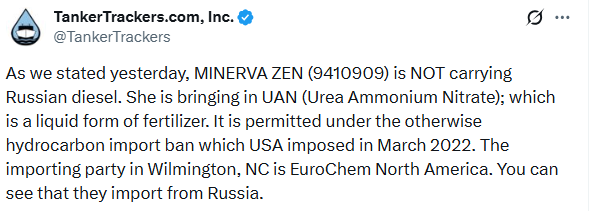
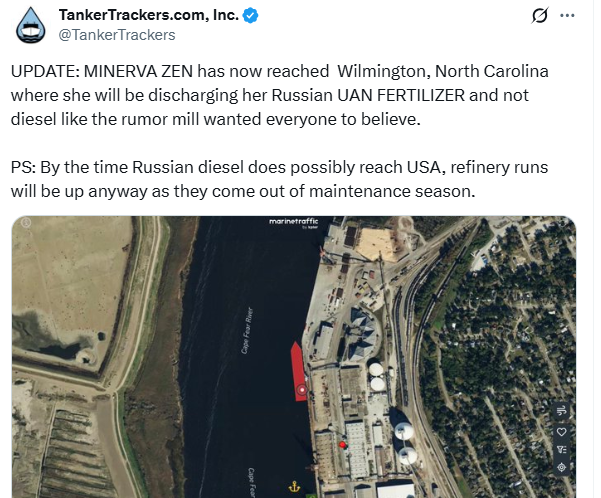
The vessel’s management company, Minerva Maritime, was asked today to confirm whether the cargo the Minerva Zen is discharging is diesel or liquid fertilizer.The company answered through Navigate Response, the press representative for Minerva Marine. According to Katerina Skourtanioti, the Minerva Zen “was transporting a liquid fertiliser cargo, urea ammonium nitrate (UAN) and not diesel.”
by Editor - Monday, October 12th, 2026 No Comments »
There has been breaking news since the podcasts with Dimitri Lascaris and Nima Alkhorshid analysing the telephone agreement on Russian diesel shipments to the US between President Vladimir Putin and President Donald Trump.
The diesel dealmaking had been under way for at least three weeks before the terms reached Putin and Trump to decide on Friday evening, Moscow time, October 9. Read more.
The podcasts followed on Saturday. Click to view or listen to Reason2Resist recorded at 9 am Moscow time, Saturday. Then live from midnight Moscow time, Dialogue Works.
Subsequently, it has been discovered and reported that a shipment of 36,000 metric tons of diesel had been loaded on the Minerva Zen, a Greek-owned and flagged tanker, in St Petersburg, which then set sail into the Atlantic in the direction of the east coast of the US, on September 22. That was seventeen days before Trump and Putin (lead image, right) reportedly concluded their deal for staged diesel shipments, commencing with a target of 300,000 tonnes in the month of October.
The Minerva Zen, according to maritime trackers, was scheduled to arrive at Wilmington, North Carolina, on Sunday evening, local time, October 11. Last year, the vessel had been carrying Russian petroleum products to Brazil. It is unclear whether Brazil was its original destination when it left St. Petersburg, and if it had received a diversion order from the Kremlin. It is also unclear who authorized the vessel to load and leave with diesel on September 22 when the Kremlin’s ban on diesel exports, introduced on July 8, was still in effect.
It is reported that Kirill Dmitriev (lead image, left), Putin’s special negotiator with Steven Witkoff (lead image, left), Jared Kushner, the Trump family, and US Treasury Secretary Scott Bessent has been negotiating terms of sanctions waivers for Russian crude oil and petroleum product exports for several months — unsuccessfully. However, during Dmitriev’s trip to New York in September they negotiated terms of an agreement on a diesel fuel waiver for Trump to discuss with Putin on Friday. When precisely the terms were agreed, and when the Minerva Zen was ordered into Wilmington port, aren’t known yet.
Dmitriev met Witkoff and Kushner in New York on September 29, Tass reported. He then went to Washington where he held “a series of meetings…including with US Treasury and Energy Department officials, sources familiar with the talks told TASS. They discussed Russian-US economic cooperation.”
By then the Minerva Zen was already one week at sea, sailing at an average speed of less than 2 knots.
On September 25, Kremlin spokesman Dmitry Peskov had said that a deal trading US sanctions relief of Russian diesel for a Black Sea and energy infrastructure ceasefire was unacceptable to Russian negotiators. “If we are talking about saturating international markets with Russian diesel fuel, about export ban lifting, it is not enough to simply provide for domestic needs, diesel fuel reserves, and open diesel fuel exports. The safety of navigation in the Black Sea should be concurrently provided. But even that is not enough. For international markets to be saturated, the diesel should come there unhindered, that is, without any sanctions, without any restrictions, and so on. Therefore, only a comprehensive solution is possible here.”
The Minerva Zen’s diesel cargo represents just 12% of the volume Trump has said has been agreed with Putin for the month of October. Yury Ushakov, another of the Kremlin negotiations with Witkoff and Kushner, told reporters after the Friday call “I am afraid I cannot fully satisfy your curiosity, colleagues, by revealing all the details of the specific issues discussed by the two presidents.”
Dmitriev has tweeted in celebration of Trump’s terms and of himself: “President Trump’s peacemaking efforts and clarity give a strong impetus to PEACE.” “In 2020, Presidents Putin and Trump jointly stabilized oil prices and markets. Today, they continue their work. The diesel supply agreement showcases the power of economic cooperation between Russia and the US and its benefits to people and the world. Cooperation will prevail.” “President Trump joins the many who believe that Ukraine needs leadership actually focused on peace, not Zelensky’s warmongering: ‘It’s time for Ukraine to get a new president.’ Iconic and historic.”
Peskov responded to the announcement of the diesel deal which Witkoff and Kushner had discussred with Ukrainian officials in Miami on Friday, just before the presidential telcon. “ ‘We know that they are holding talks with the Ukrainians in the United States today. There allegedly are some comprehensive plans and ideas for a settlement. If these are indeed discussed in Miami, and if the American negotiators deem it necessary to share them in Moscow, then, of course, come on over,’ he added.”
The day before, Peskov had dismissed proposals from the Indian foreign minister for an “energy ceasefire” as “piecemeal”. “We have also repeatedly said at various levels that we favor a comprehensive solution rather than a piecemeal one, a solution that would lead to a lasting settlement for many, many years, for decades.”
From maritime industry sources, it is now certain the Minerva Zen’s cargo will be discharged on Monday and Tuesday of this week at the fuel terminal in Wilmington owned by Jared Donnelly and his family. Donnelly has been rewarded by substantial donations to the Trump campaigns by the appointment of Donnelly as the US Ambassador to New Zealand.
In the meantime, Russian and Ukrainian sources have reported that there was a Ukrainian attack with more than 50 drones on a Russian oil loading terminal in Rostov region on Saturday evening, several hours after the presidents had spoken.
The next evening, Sunday, the Ukrainian attack involved more than 900 drones on Russian targets, but reportedly no refineries or other energy infrastructure. In Vladimir, the electric, heat and water supply was disrupted, and a third data centre of Yandex (previously hit in the Ryazan and Kaluga regions) was also attacked. In Lysychansk, 2 civilians were killed and 13 others were injured. There were fires on the territory of the airport in Sochi; also the wreckage of the drone fell on the territory of private homes and hotels in the area. There were no casualties.”
Over the same Sunday evening, the Russian operations struck at “8 regions of Ukraine at night. In 4 districts of Kiev, emergency shutdowns were introduced after Russian strikes. In the Buchansky district, the warehouses of the Synthesis Group were burned by the Geran-5 strikes. The Tenet data centre in Odessa was hit; in the port of Chernomorsk dry cargo stocks were attacked…Locomotives in Odessa and Dnipropetrovsk region are affected.”
Energy infrastructure targets hit included the Kievskaya electric substation in Kiev and the turbines of the Zmievskaya Thermal Power Plant and a gas pipeline passing through the territory of the plant.
Trump tweeted on Sunday afternoon, his time: “Effective immediately, there is an ENERGY CEASEFIRE in the War between Russia and Ukraine. Both parties have agreed. Do not break it! Thank you for your attention to this matter.”
Independent military blogger AMP Mapping responded, corroborating Tsarev’s reports: “In case it wasn’t already obvious, Trump’s statement about an energy ceasefire is a lie. Russian Geran-4/5 jet-drones have been attacking various energy facilities in Ukraine, including the TEC-5 Thermal Power Plant near Kharkov, the 750 kV Kievskaya Substation, and the 330 kV Novokievskaya Substation, among others.”
Zelensky responded to Trump’s ceasefire claim through the Israeli-American propaganda sheet, Axios: “It was news to me. But if the Russians agree, Ukraine will also agree. Let us know when the truce begins.”
Peskov replied: “Vladimir Zelensky is currently hysterical and incapable of taking deliberate action; if he were rational, he would be open to peace talks, Kremlin Spokesman Dmitry Peskov told Vesti reporter Pavel Zarubin. ‘Zelensky, naturally, being in a state of hysteria, is hardly capable of taking any deliberate actions right now. If he were capable of doing so, he would show a willingness to engage in peace talks,’ the spokesman noted.”
Repeating Trump, Dmitriev tweeted: “The Ukrainian election is coming.”
Ukrainian, European, and British officials then told the Financial Times in London to report that “the Trump administration is threatening to stop the procurement system that provides Ukraine with weapons in order to press Kyiv to halt its deep strikes on Russian energy infrastructure, according to officials in Europe. The officials, who received calls from American officials on Saturday and Sunday or were briefed on them, said the US was lobbying European capitals and Kyiv in an attempt to end the attacks on Russian oil refineries. The White House declined to confirm or comment on the calls. The US message, the officials added, included threats to cut off intelligence sharing and PURL — the Prioritised Ukraine Requirements List mechanism for procuring US weapons for Ukraine. ‘They are calling Kyiv…they are calling everyone [in Europe]’ said an official who received a call from a US defence official. PURL is a NATO-managed initiative through which Kyiv’s allies purchase US-made weapons that are then supplied to Ukraine. The US does not make a financial contribution to the fund. One person who said he was contacted by US officials was Pavlo Palisa, Volodymyr Zelenskyy’s military adviser and former general of Ukraine’s 93rd mechanised brigade.”